

March 23, 2023
AttackIQ has released two new attack graphs that emulate recent activities conducted by the Chinese adversary known as Mustang Panda. The actor leveraged a historical family of malware known as PlugX, which is shared between multiple groups of Chinese origin known, and a new previously unknown backdoor exclusive to this actor.

March 23, 2023
AttackIQ has released two new attack graphs that emulate recent activities involving the banking trojan known as BokBot, which has been primarily focused on exfiltrating data and stealing credentials. This new release continues our focused research on emulating shared e-crime malware used in attacks by multiple adversaries.

March 17, 2023
AttackIQ has released a new fully featured attack graph that emulates the behaviors demonstrated by the latest version the LockBit ransomware family “LockBit 3.0”, also known as “LockBit Black.”
March 17, 2023
AttackIQ has released a new attack graph that emulates the Tactics, Techniques, and Procedures (TTPs) used by a cybercriminal-focused adversary who carried successfully exploited CVE-2019-18935 against an instance of Telerik UI at a federal civilian executive branch (FCEB) agency.

March 16, 2023
For malicious actors, opportunity can be found in the mundane. As adversaries continue to refine their approach with newer and more sophisticated methods to perform malicious activity, it is critical for detection engineers to stay up to date in the latest threat intelligence and adversary behaviors to monitor.

March 3, 2023
AttackIQ has released a new fully featured attack graph that emulates the tactics, techniques, and procedures (TTPs) observed in cyberattacks involving Royal Ransomware.

March 3, 2023
AttackIQ has released a new fully featured attack graph that emulates the tactics, techniques, and procedures (TTPs) associated with a 2020 intrusion from the cybercriminal group TA551.

February 27, 2023
Reactive to Preactive. Atomic to Anatomic. Lists to Graphs. Simulation to Emulation. To be prepared for the next attack, defenders must adapt and shift their focus to a threat-informed defense, to think like the adversary, and to test their security programs in a realistic manner.
February 17, 2023
AttackIQ has released two new attack graphs emulating recent Emotet campaigns that resulted in data exfiltration and ransomware extortion. This release continues our focused research on shared e-crime malware used in attacks by multiple threat actors.

February 14, 2023
AttackIQ is democratiziing the practice of threat-informed defense and adversary emulation, including by funding research from the Center for Threat-Informed Defense on micro-emulation planning. Learn more out how we put adversary emulation into practice in the AttackIQ Security Optimization Platform.

February 3, 2023
AttackIQ has released two attack graphs that emulate the shared cybercrime malware loader known as BumbleBee. This release is a continuation of our cybercrime malware emulation initiative detailing how customers can protect themselves against a wide range of actors who share tooling.

January 25, 2023
AttackIQ has released three new attack graphs that emulate multiple infection chain variations involving the widely utilized cybercrime malware known as QakBot.

January 5, 2023
AttackIQ has released a bundle of content consisting of six new attack graphs that seek to emulate the campaigns and operations led by the infamous North Korean-sponsored adversary Lazarus Group against entities worldwide across multiple sectors.

December 22, 2022
AttackIQ has released a bundle of content that includes three new attack graphs that seek to emulate different cyberspace operations led by the North Korean-sponsored threat actor Andariel against multiple entities located in Asia, predominantly in South Korea, through the use of downloaders, backdoors, and custom ransomware.

December 19, 2022
AttackIQ has released a new attack graph that seeks to emulate the activity carried out by the politically motivated Pakistan-based adversary known as APT36 or Transparent Tribe. This newly released attack graph emulates the behaviors observed in attacks against victims working in Indian government organizations.

December 14, 2022
AttackIQ has released a bundle of content including four new attack graphs that seek to emulate two types of attacks conducted by the North Korean adversary BlueNoroff. The newly released graphs emulate the behaviors used in the attacks against the Society for Worldwide Interbank Financial Telecommunication (SWIFT) software and organizations involved in cryptocurrency.

December 13, 2022
OpenAI’s ChatGPT can tell you exactly how to use BAS to improve your cyberdefense effectiveness. But it won’t help you with the Russian military specifically, and that’s a very good thing. See below for why OpenAI deserves credit for this algorithmic limit.
December 12, 2022
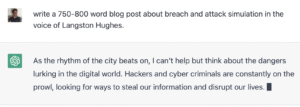
We asked OpenAI’s ChaptGPT to write a 750-800 word blog post about breach and attack simulation (BAS) in the voice of Langston Hughes. It did great; see below. And well-done, team OpenAI.

December 8, 2022
A look back at how AttackIQ’s customers and advanced research, as well as key players in the analyst community, helped propel the breach and attack simulation market forward in 2022.
December 3, 2022
AttackIQ has released a new fully featured attack graph that emulates the tactics, techniques, and procedures (TTPs) associated to attacks involving Cuba ransomware.This release is a follow-up to an FBI FLASH alert published in December 2021 that first detailed the initial attacks against 49 entities in critical infrastructure sectors. The Cuba ransomware actors have since doubled the number of U.S. victims and compromised over 100 entities worldwide.

November 18, 2022
AttackIQ has released a new fully featured attack graph that emulates the tactics, techniques, and procedures (TTPs) observed in attacks by cybercriminal groups to deploy their Hive ransomware.

November 17, 2022
AttackIQ has released a new fully featured attack graph that emulates the tactics, techniques, and procedures (TTPs) observed in an attack by Iranian-sponsored adversaries against a Federal Civilian Executive Branch (FCEB) organization in the U.S.

November 3, 2022
What is the correct way to validate your controls against a Text4Shell or similar library vulnerability? You need an adjustable, open systems testing platform to test the specific aspects of your implementation to accurately assess if your security controls are correctly configured to stop attacks that leverage it.

October 31, 2022
One of Ash Carter’s former speechwriters and special assistants reflects on the lessons the Secretary of Defense leaves behind.