Power SOC Transformation with Continuous Detection Engineering
Eliminate false positives, uncover silent failures, and ensure your detection rules are aligned to real threats and operational priorities.
What Detection Engineering Actually Means for Your SOC
Detection engineering empowers security teams to continuously validate detection rules against real-world adversary behaviors, ensuring high-fidelity alerts and reducing noise in the SOC. This systematic process includes generating, interpreting, validating, and measuring detection rules to stay current with emerging threats, reduce false positives, and accelerate incident response.
Within the CTEM lifecycle, detection engineering supports both the Validation and Mobilization phases. In Validation, teams confirm whether existing controls effectively detect adversary behaviors. In Mobilization, when gaps are identified, new detection rules are created and deployed to restore coverage and improve detection performance.
AttackIQ automates this process through adversarial exposure validation aligned with the MITRE ATT&CK framework, enabling teams to test detection rules in production and respond quickly when gaps are uncovered.
Download the White PaperFrom Static Detection Rules to Continuous Validation
SOCs are overwhelmed by noisy alerts and missed threats. Continuously validate detection logic against real adversaries, enabling you to find failures fast and stay ahead of attacks.
The Old WayStatic Detection Rules
- Outdated detection rules break silently and go untested
- False positives overwhelm analysts and bury real threats
- Testing rules requires manual effort and custom scripts
- Coverage gaps are only discovered after incidents or through manual reviews
- Rule performance is untracked and decays over time
- Institutional knowledge lives in spreadsheets and tribal memory
The AttackIQ WayContinuous Detection Engineering
Stronger Defense Starts with Smarter Detection
Find Broken Detections Before Attackers Do
Continuously validate rules in production to uncover silent failures before they create blind spots.
Clean Up Detection Sprawl
Remove stale, noisy, and misconfigured rules that overwhelm analysts and obscure real threats.
Free Up Analysts for High-Value Work
Reduce unnecessary investigations so your team can focus on threat hunting, incident response, and proactive defense.
Prove Detection ROI to Leadership
Use validation metrics to demonstrate coverage, fidelity, and measurable improvements in security posture.
Detection Engineering, Perfected from Start to Finish
Detection Engineering in Action
See how leading organizations operationalized detection engineering with AttackIQ—achieving measurable gains in detection accuracy, response speed, and team efficiency.
Healthcare
National Provider Network Strengthens Detection Coverage
Challenge: A large healthcare system needed reliable Sigma rule validation across endpoint and log sources.
Results:
Financial Services
Fortune 100 Bank Optimizes Detection Engineering
Challenge: A global financial institution with mature security programs needed scalable detection validation.
Results:
Automotive
Global Industrial Leader Automates Detection Workflows
Challenge: An automotive leader needed to validate detection logic across enterprise IT and connected vehicle systems.
Results:
Manufacturing
Global Vehicle Manufacturer Secures Complex Environment
Challenge: A multinational manufacturer needed standardized detection validation across distributed SOC teams.
Results:
Detection Engineering FAQ
Traditional detection testing often relies on static samples that don’t reflect real adversary behavior. AEV uses full attack chains mapped to MITRE ATT&CK to emulate how actual threats operate in your environment, providing more accurate validation of detection rules against sophisticated techniques used by today’s threat actors.
Most organizations begin validating detection rules within days of implementation. Our platform includes pre-built adversary emulations and integration with common security tools (Splunk, Microsoft Defender, CrowdStrike, etc.), enabling rapid deployment and immediate value for security operations teams.
Yes, AttackIQ excels at validating custom detection rules, including Sigma, YARA, and proprietary formats. Security teams can test rules before deployment and continuously validate them in production environments to ensure they remain effective as both threats and infrastructure evolve.
By validating detection rules against real-world scenarios, AttackIQ helps teams identify and eliminate false positives that contribute to alert fatigue. This process improves signal quality, allowing SOC analysts to focus on legitimate threats while reducing the noise from misconfigured or overly sensitive detection logic.
Attack path mapping shows how adversaries move through your environment. By linking detections to these paths, you can pinpoint gaps in coverage and improve rule placement for maximum disruption.
Detection engineering is not a one-time exercise. As threats evolve and environments change, rules must be continuously tested and refined. With AttackIQ, validation becomes part of the workflow—helping teams adapt and maintain detection accuracy long-term.
Measure What Matters
The Goal Is Not Fewer Findings
It’s Less Threat Debt
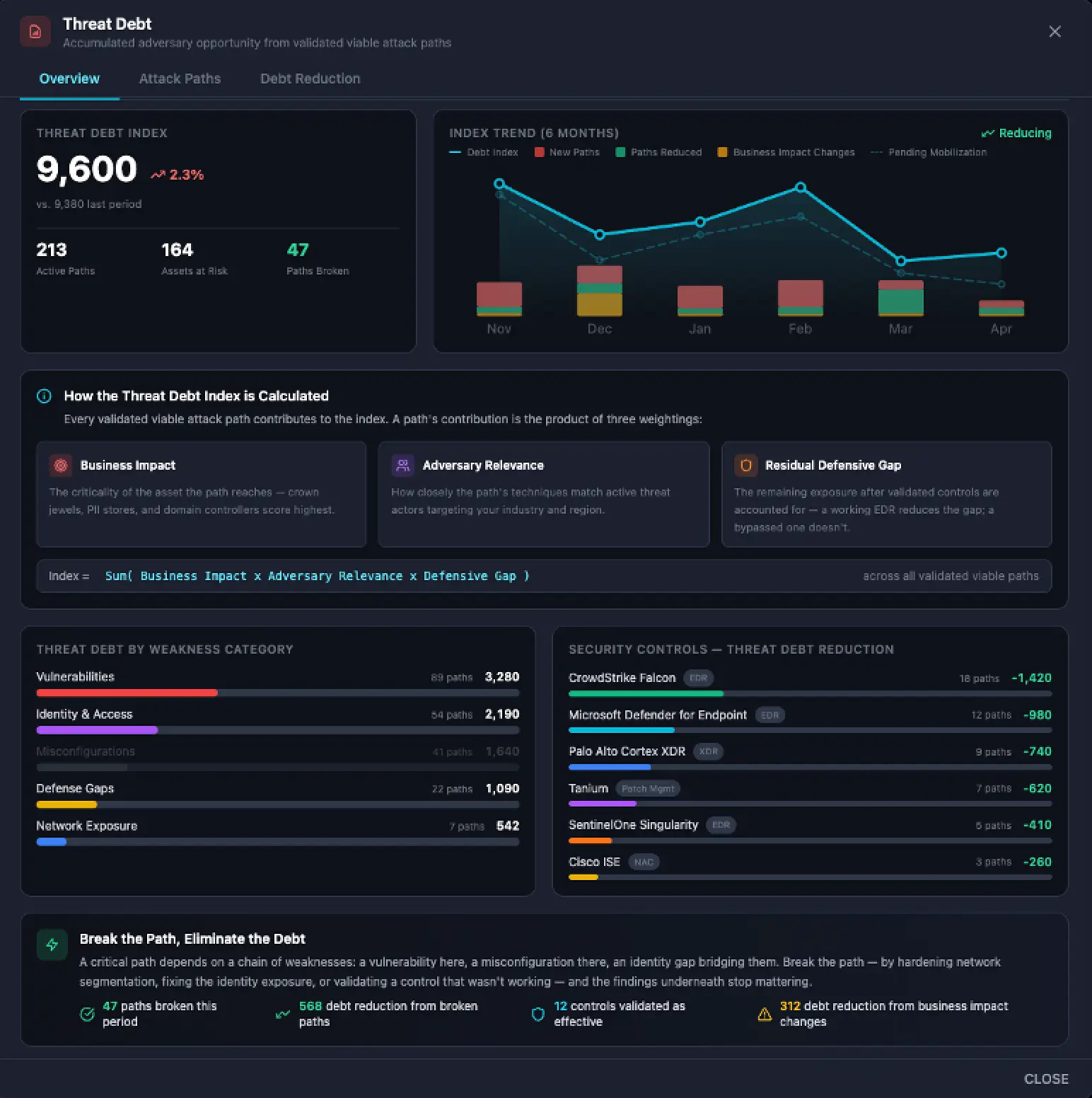
See which attack paths matter, which controls fail, and which actions measurably reduce threat debt in your environment.