Why vulnerability counts no longer measure risk, what threat debt actually is, and how a single index turns exposure into a number your board can act on.
The scoreboard everyone reports
Walk into almost any board meeting and the security update looks the same: vulnerability counts, patch SLA adherence, and compliance status. It’s the scoreboard the industry built over two decades, and everyone has learned to read it.
The problem is simple. None of those numbers are what adversaries actually exploit. They measure effort — how busy the team is — not exposure — how reachable your critical assets really are. A program can be green on every metric and still be one identity hop away from a breach.
What changed: AI broke the math
The old model assumed you had time — time to find, rank, and patch before anyone weaponized a flaw. Adversaries automated that window away. Discovery, exploit development, and delivery now happen at machine speed, and the patch-everything approach simply can’t keep pace.
The deeper problem is selectivity: only a small fraction of disclosed vulnerabilities is ever exploited. Counting and patching everything spends your budget on findings adversaries never touch — while the few paths they do use go unaddressed.
What you’re actually exposed to
There is a name for the real exposure hiding underneath the scoreboard: threat debt.
Threat debt is the contextualized, path-organized burden of every error and gap in your environment — weighed against the adversaries that target you and the assets you can’t afford to lose. Like technical debt, it accrues continuously, compounds when ignored, and can’t be eliminated by working faster on the wrong items. Unlike technical debt, the cost of ignoring it isn’t slower development — it’s exposure to breach.
Threat debt is the true adversary opportunity in your environment. For most security programs, it’s growing faster than it can be closed — and it doesn’t show up in the metrics that get reported to leadership.
It helps to be precise about what threat debt is not. It isn’t a vulnerability backlog — two organizations with identical backlogs can carry very different threat debt. It isn’t attack surface — surface is what’s exposed; threat debt is what’s exploitable in combination. And it isn’t a rebrand of Continuous Threat Exposure Management — CTEM is the operating discipline; threat debt is what that discipline operates on.
Threat debt doesn’t accumulate in one place. It emerges where seven sources combine into viable paths to what matters:
- Vulnerabilities. Known flaws in operating systems, applications, libraries, firmware, and services.
- Misconfigurations. Over-permissive access, default credentials, and resources left more exposed than intended.
- Control weaknesses. Controls that pass compliance but fail under test — visible only through continuous validation.
- Identity & access debt. Excessive privileges, stale accounts, and weak auth paths — the connective tissue of most breaches.
- Detection & response debt. Missing or misaligned detection logic and playbooks that can’t execute at machine speed.
- Network & segmentation debt. Firewall errors, permissive east-west traffic, and flat networks adversaries traverse freely.
- AI & automation debt. Unmanaged AI agents, automation frameworks, and MCP servers operating without discipline.
A better unit of measure
If threat debt is the right thing to measure, the next question is how to separate signal from noise. A finding only becomes threat debt when it survives three questions — the attack path test:
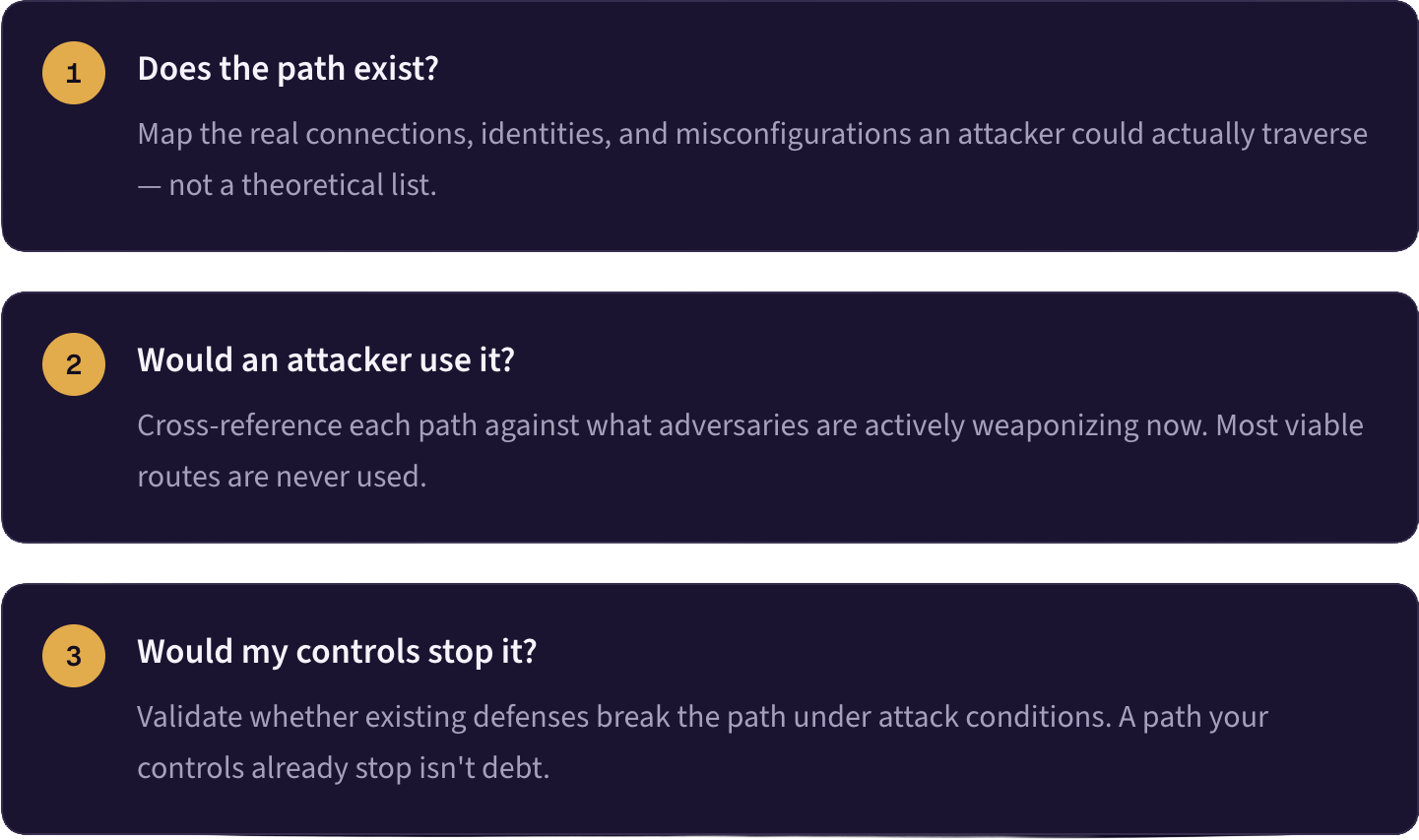
A path that exists, that adversaries use, and that your controls fail to stop is real threat debt — the opportunity worth paying down first. Everything that fails a question is noise you can stop paying for. This is how three questions turn 20,000 findings into a short list.
The Threat Debt IndexTM: a balance, not a posture score
Every validated attack path contributes to a single number — the Threat Debt Index — weighted by business impact, adversary relevance, and the residual gap after proven controls. Every point traces back to a specific path, so a lower Index means fewer viable paths to your crown jewels and a measurably lower probability of breach — which is why it behaves like a debt balance rather than an opaque score:
STOCK: the current balance — total adversary opportunity carried today.
FLOW: the net change over a period — debt paid down minus debt accrued.
The sentence boards need
“The Threat Debt Index is 612, down 14 points this quarter — 60 paid down, 46 accrued.”
Two properties make the Index trustworthy. It credits the controls you already have— a compensating control that demonstrably breaks a path reduces the debt that path carries, so you’re measured on real residual exposure, not gross findings. And it prices the fix before you make it— you can model the forward-looking return of a remediation plan, in points paid down, before committing the budget to execute it. The number isn’t asserted; it’s derived from live environment, threat, and control data, and it moves only when real exposure changes.
The AttackIQ Agentic OS that runs it
A number on its own changes nothing. Threat debt is paid down through a discipline — CTEM — a continuous loop that scopes what matters, finds the viable paths, validates which ones your controls actually stop, and mobilizes the fixes that retire the most debt. It never stops, because adversaries never do.
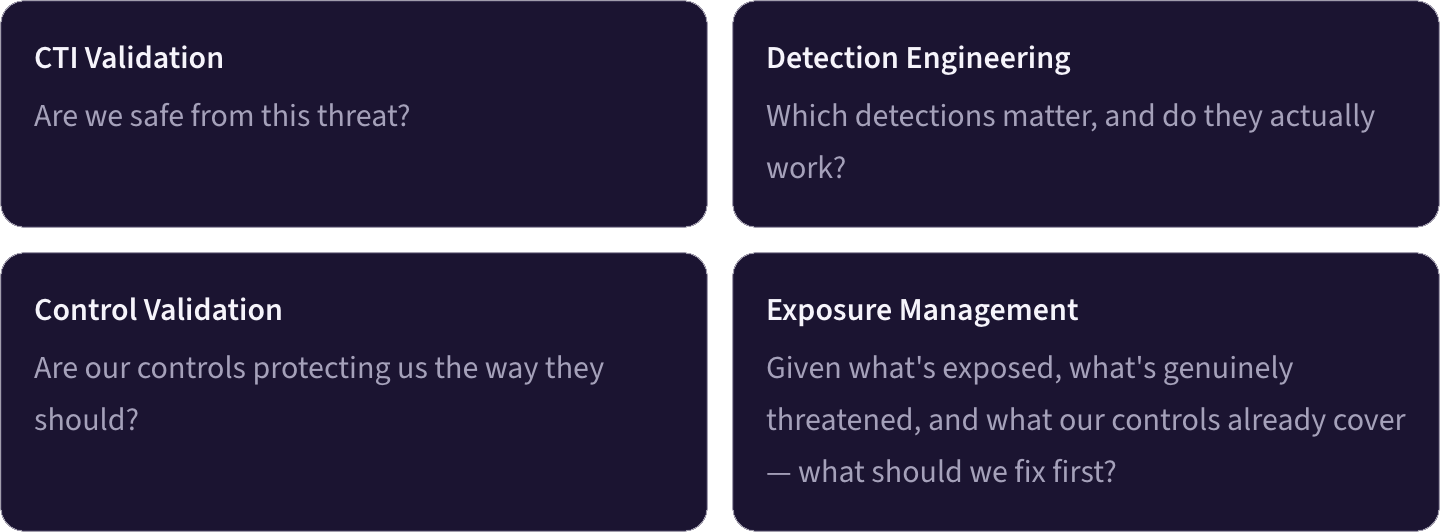
Running that loop by hand doesn’t scale. AttackIQ’s Agentic OS runs it for you, across four workflows inside one harness — each answering a question enterprise security teams are already buried under:
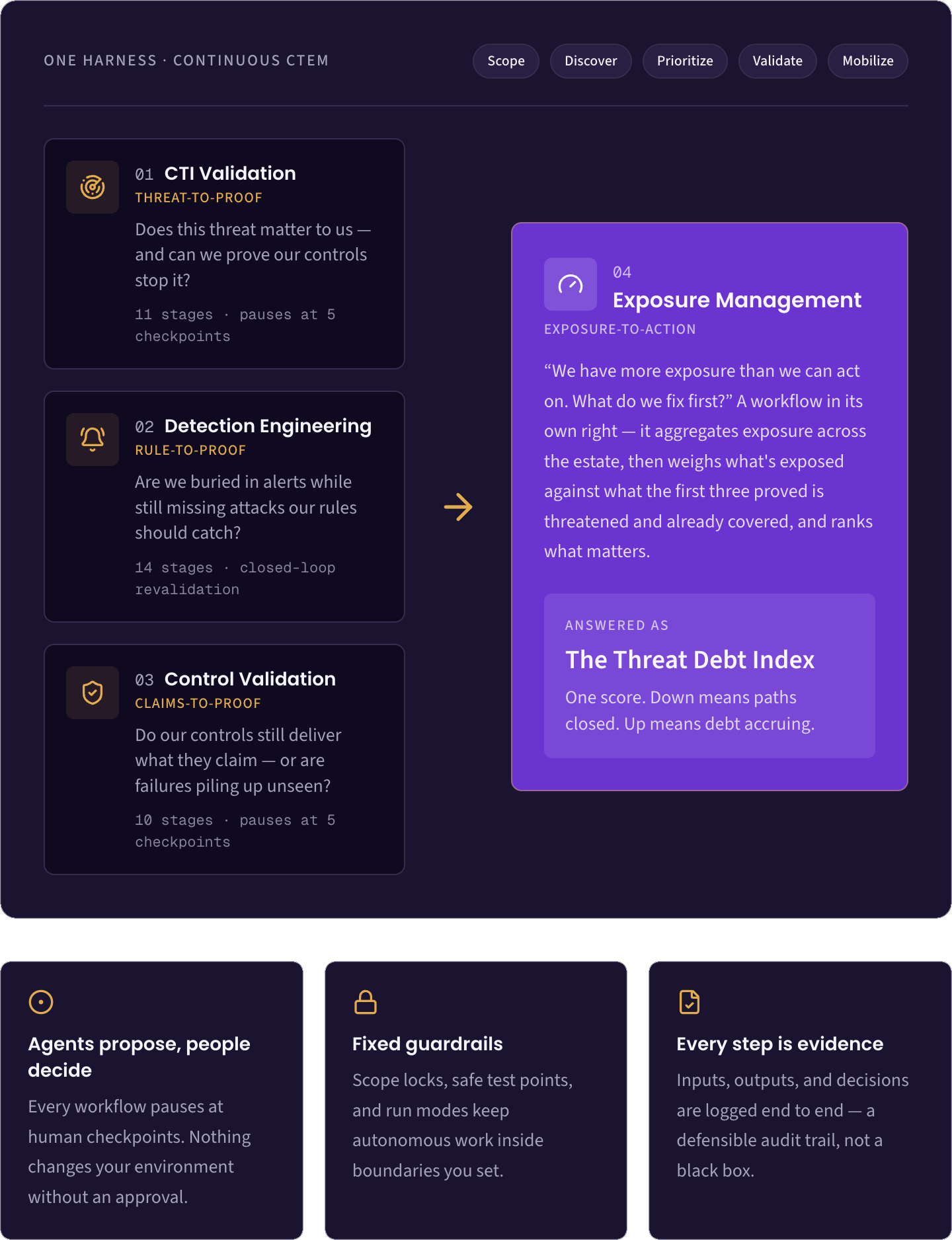
Autonomous agents run the work continuously, but they stay inside fixed guardrails, pause at human checkpoints, and log every step. CTI Validation, Detection Engineering, and Control Validation produce proof— real threat relevance, real detection performance, and real control effectiveness. Exposure Management turns that proof into priority, aggregating exposure across the estate to identify the fixes that retire the most debt. That output, expressed as one score, is the Threat Debt Index.
And the Index isn’t one monolithic model. It’s driven by a team of specialized agents, each paired with the model best suited to its job, each paying down a specific source of debt. As those agents close validated paths, improve detection coverage, prove control effectiveness, and verify remediation, the Index moves for a reason: your likelihood of breach is going down.
One agent per source
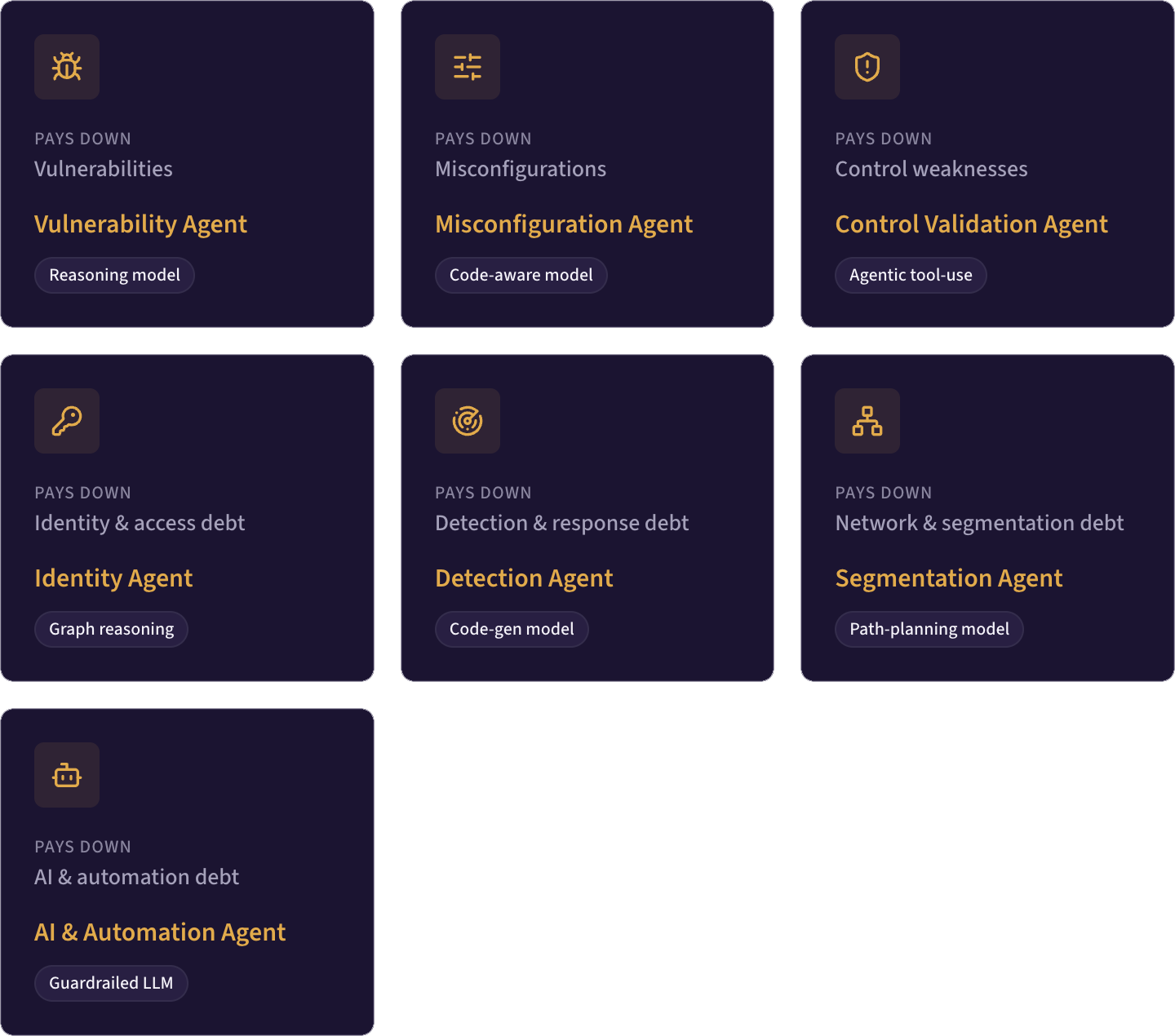
Each source of debt gets a purpose-built agent.
The seven sources of threat debt each map to a dedicated agent inside the harness — paired with the model best suited to the job. Working the same checkpoints and guardrails, they close the paths that drive the Index down.
The payoff
When threat debt becomes the unit of measure, the whole program lines up behind one scoreboard. Prioritization, validation, and board reporting stop telling three different stories. Security and IT share a vocabulary for a problem they own together. And leadership finally sees a number that reflects real exposure — one that goes down when the team breaks the paths that matter, and up when it doesn’t.
That’s the shift: from measuring how hard you worked to measuring how exposed you are — and proving, quarter over quarter, that the gap is closing.